Theory and Practice in the Curriculum

Theory and Practice in the Curriculum

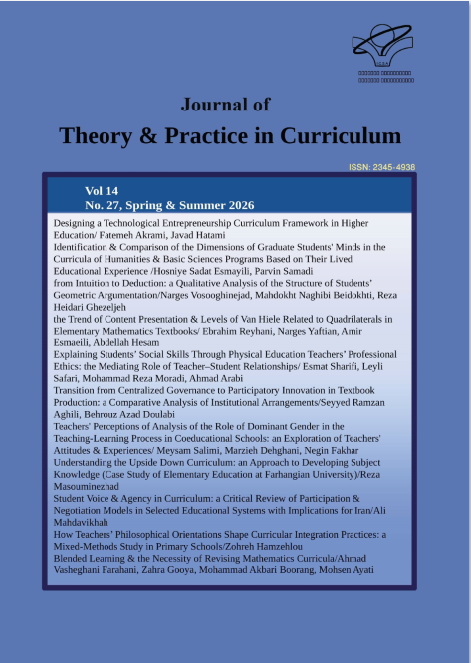
Current Issue: Volume 13, Issue 26, March 2026, Pages 1-343 

The purpose of publishing “Journal of Theory & Practice in Curriculum” is to make research contexts in the curriculum field and develop and distribute the knowledge of curriculum which is needed in society. So each paper which is written about one of the educational and psychological sciences in the curriculum field and contains the new findings and ideas in the curriculum can be accepted for considering and printing.

Indexing and Abstracting

Keywords Cloud

  • Curriculum
  • Higher education
  • content analysis
  • Farhangian University
  • Elementary School
  • Teachers
  • Phenomenology
  • Professional Development
  • evaluation
  • teacher education
  • lived experience
  • hidden curriculum
  • Mathematics Curriculum
  • textbook
  • curriculum implementation
  • high school
  • Science
  • Primary School
  • Curriculum Elements
  • Entrepreneurship
  • Textbooks
  • internship
  • Education
  • teachers\' experiences
  • Artificial intelligence
  • mathematics education
  • Grounded theory
  • comparative study
  • Pathology
  • integration
  • research synthesis
  • phenomenography
  • Lived experiences
  • science education
  • ethnicity
  • elementary course
  • Employability
  • Curriculum theory
  • curriculum studies
  • National Curriculum
  • Curriculum Design
  • Causal layered analysis
  • art
  • Middle School
  • integrated curriculum
  • Mentally retarded children
  • attained curriculum
  • Moral education
  • mathematics teaching
  • student-teachers
  • content
  • Qualitative Content Analysis
  • Teaching Experience
  • synthesis research
  • creativity
  • Trigonometry
  • children
  • Performance improvement
  • Teacher Training
  • theorizing
  • Curriculum Model
  • Virtual Education
  • Math Curriculum
  • science curriculum
  • pedagogy content knowledge
  • Algebra
  • curriculum evaluation
  • William Pinar
  • Validation
  • Open-ended problems
  • Curriculum Development
  • Entrepreneurship Components
  • qualitative research
  • Students
  • Components of curriculum
  • Instruction
  • Primary school teachers
  • medical education
  • Multicultural Education
  • Teacher knowledge
  • nature of science
  • Student agency
  • Gender
  • job empowerment
  • Mathematics
  • Representation
  • School mathematics
  • Preschool level
  • Neuro-phenomenology
  • : curriculum
  • Narrative Inquiry
  • Elementary school teachers
  • teacher
  • historical research
  • Descriptive Evaluation
  • Current-Desired Status Gap
  • Community of Inquiry
  • case study
  • Interdisciplinary and transdisciplinary
  • Physics Education
  • Electrotechnical field
  • mathematical reasoning
  • experienced curriculum
  • learning to know
  • Designing curriculum
  • personal practical knowledge
  • student centered
  • dialogic education
  • scendary school
  • Nomads
  • diffused identity
  • Curriculum Based Measurement
  • meta
  • modelling
  • Computer Supported Collaborative Learning paradigm
  • web-based assessment
  • essay
  • Practice
  • child agency
  • epistemological foundations
  • curriculum counseling
  • Teacher professional development
  • Teacher competencies
  • self-learning package
  • Tyler model
  • Collaborative Innovation
  • citizenship education
  • emergent grounded theory
  • Layered Curriculum
  • statistics homework
  • research supervision style
  • sixth grade students
  • secondary education
  • Architecture
  • conceptualization
  • practical knowledge
  • Practical Curriculum
  • mathematical modeling problems
  • Cognitive competence of ICT
  • Components and Indicators
  • preschool curriculum
  • application of integration
  • content structure
  • Generational characteristics
  • mixed-sex schools
  • components
  • collaborative learning
  • Instagram
  • Integration
  • childhood
  • Realistic Mathematics Education
  • Selection of Content
  • Educational Design
  • objective
  • Skills-Based Higher Education System
  • practical theory
  • statistics curriculum
  • higher education curriculum
  • humanities
  • Sports 1
  • Mathematics Educators
  • background and strategies
  • Coronavirus Pandemic Crisis
  • models of teacher knowledge
  • Choice of field
  • Comparative
  • Parallel teaching
  • Program of Professional Development of Elementary Teachers
  • Islamic action theory
  • Elementary Persian Books
  • Blind and low vision students
  • Moodle\'s forum
  • constructivism
  • Persian Curriculum
  • emergence
  • Prospective Elementary Teachers
  • Indigenous Pedagogy
  • theories of curriculum
  • Upper Secondary School
  • model
  • Personalized Curriculum
  • Pedegogy
  • Orientation
  • Self-determined
  • Museum
  • reflective practice
  • university professor
  • Mother Tongue
  • Evert Rogers
  • Mathematical Modeling
  • new internship program
  • Curriculum Facilitation
  • Design for teaching paradigm
  • bicultural art experience
  • student experiences
  • Conceptual model
  • generation z
  • understanding
  • Keyword Homeschooling
  • Template

Related Journals